
Solid Contact Rivets
A contact rivet formed from one specified material through the head and shank.
Solid Contact Rivets · 1 / 3
Part details
- Type
- Solid contact rivets
- Materials
- Ag, AgNi, AgSnO2, AgCdO, Cu, and specified materials
- Applications
- Relays, switches, contactors, circuit breakers
- Key dimensions
- Key dimensions confirmed by drawing or sample
Sampling & supply
- Sample development
- Available after technical review
- Production MOQ
- Confirmed by part, material, tooling and production arrangement; sample and trial quantities assessed separately
- Sample lead time
- Typically 5-10 working days after technical review and agreed start conditions
- Production lead time
- Typically 15-20 days after technical review and agreed start conditions
Form the head and shank from one specified material.
Head and shank profiles
Flat, rounded and short-shank forms provide different interfaces for assembly.
Match the material
Choose the specified contact material for the forming process, assembly, and destination market.
Shape the assembly interface
Define the head profile, shank form, and the way the rivet joins the customer assembly.
Set a repeatable specification
The approved drawing, specification, and sample guide production and inspection.
Dimensions to confirm
Confirm the material, head profile, shank form, and assembly interface for each solid rivet.
| Dimension | How confirmed |
|---|---|
| Head diameter D | Drawing or sample |
| Head thickness T | Drawing or sample |
| Shank diameter d | Drawing or sample |
| Shank length L | Drawing or sample |
| Head profile / radius R | Drawing or sample |
Confirm these dimensions and tolerances from the drawing or sample, material system, and project review before production.
- Head diameter, head thickness, shank diameter, shank length, and radius are confirmed from the drawing or sample.
- Material shape, surface condition, and assembly interface are reviewed together.
- Final dimensions and tolerances follow the approved drawing or sample.
Understand the Structure and Key Features
Solid
One specified material forms both the head and the shank.
- Working contact face
- Same specified material through the head and shank
Compare the contact material, conductive support and joining method.
Manufacturing & inspection
Manufacturing route
The material and head-and-shank geometry determine the forming route.
- Specified material preparation
- Rivet forming to the approved head and shank profile
- Finished surface condition selected for the part
- Sampling before the production specification is finalized
Inspection focus
Inspection focuses on the features that establish a reliable assembly interface.
- Key dimensions and head/shank geometry
- Visual condition and finished surface
- Approved material and customer requirements
- Sample-to-production consistency
Materials & applications
Material systems
- Ag and silver-alloy material systems
- AgNi, AgSnO2, AgCdO, Cu, and specified materials
- One specified material across the head and shank
Typical applications
- Relays
- Switches
- Contactors
- Circuit breakers
Related technical data
Check the material data before selecting the material and manufacturing process.
Lock the material and assembly interface before sampling.
Share the required material, head profile, shank geometry, finish, and joining interface.
- 01Share the application and any drawing, sample or photo you have.
- 02We review feasibility and quote from sufficient drawings or specifications.
- 03We agree any sample or process validation required for your part.
- 04Production starts after the agreed validation and written approval.
Related product families
View all products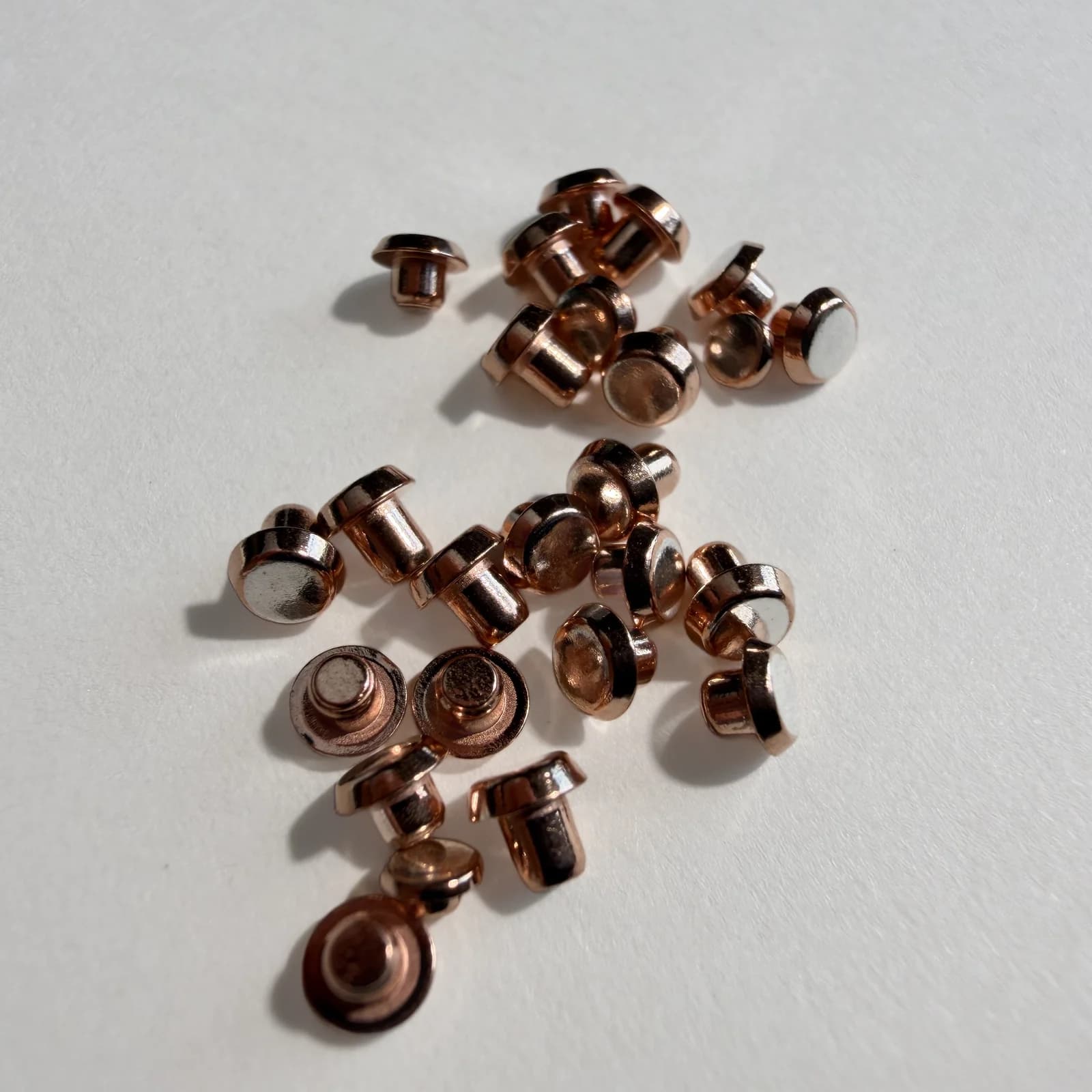


Need a solid rivet in a specific material or profile?
Send the material, drawing, sample, or photo for a focused check.